
Quick answer: Rootstown doesn’t have a treatment center inside town limits, but that doesn’t mean help is far away. Families here typically start with a phone call to an outpatient provider serving Portage County, get a quick assessment over the phone, and choose between a few levels of care built around work, farm, or family schedules. Most people can start within days, not weeks, and many never have to put their regular life on hold to do it.
If you’re reading this from Rootstown, you’ve probably already noticed the problem. You search “rehab near me,” and what comes back is a wall of directory listings pointing you toward Ravenna, Kent, or somewhere thirty minutes off. None of them tell you what to actually do next. This guide is meant to fill that gap.
Why Getting Help Feels Harder in a Small Town Like Rootstown
Rootstown is a town where people still wave from their porches and know each other by name. That’s part of what makes it a good place to live. It’s also part of what makes asking for help with addiction feel so much heavier here than it would in a bigger city.
There’s no clinic on Main Street to quietly walk into. Everyone knows whose truck is parked where, and word travels fast between the farms, the diners, and the halls of NEOMED. So when someone in Rootstown is struggling with alcohol, opioids, or another substance, the hesitation isn’t usually about whether help exists. It’s about being seen looking for it.
That worry is real, and it deserves a real answer, not just a list of phone numbers. We’ll get to that.
The First Step: Recognizing When It’s Time to Reach Out
Addiction rarely announces itself all at once. It shows up in smaller ways first, and families in rural areas often catch these signs later simply because there’s more room to hide.
A few things worth paying attention to:
- Missing work, church, or family events that used to matter
- Mood swings that don’t match what’s actually happening in the day
- Money that seems to disappear without a clear reason
- Physical changes like weight loss, poor sleep, or looking unwell
- A shift in who someone spends time with, or pulling away from old friends altogether
None of these on their own means someone has a substance use disorder. But a pattern of them, especially paired with a gut feeling that something’s off, is worth taking seriously. Waiting for a crisis before reaching out almost always makes recovery harder than starting early.
If you need to talk to someone today, before you’ve decided on a provider or a program, the SAMHSA National Helpline (1-800-662-4357) is free, confidential, and available around the clock.
Understanding Your Options: Outpatient Care Isn’t One-Size-Fits-All
One of the biggest misunderstandings we hear from Portage County families is that “rehab” means checking into a facility and disappearing from daily life for a month. For most people, that’s not what treatment looks like anymore, and it’s not the only path to lasting recovery.
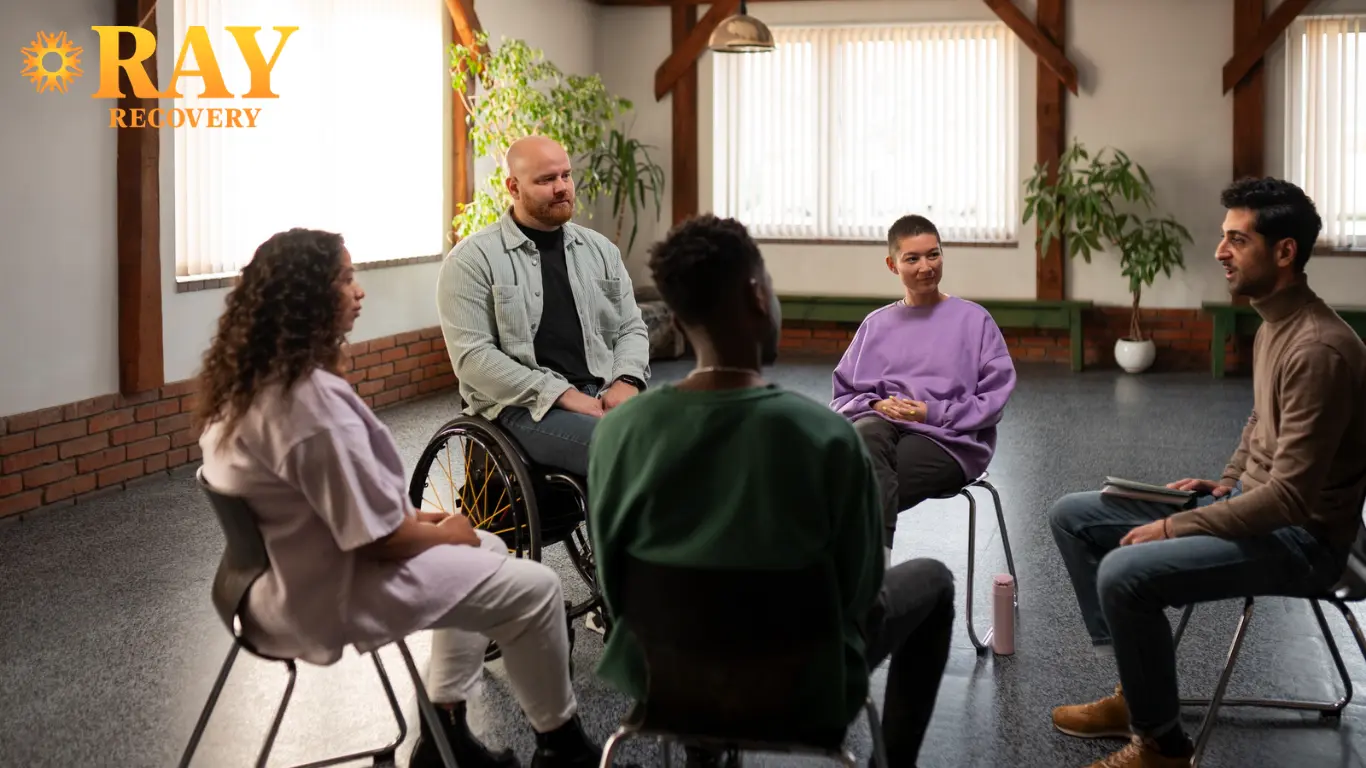
Outpatient care comes in a few different levels, and picking the right one usually comes down to how much structure someone needs right now.
Partial Hospitalization Program (PHP)
This is the most intensive outpatient option, usually several hours a day of therapy and clinical support, but clients go home each evening instead of staying overnight. It works well for people who need serious structure early on but don’t need round-the-clock supervision. You can read more about how Partial Hospitalization Programs are structured and who they’re built for.
Intensive Outpatient Program (IOP)
IOP asks for a smaller weekly time commitment, usually a few sessions spread across several days, so someone can keep working or handling family responsibilities while still getting real clinical support. It’s often the right fit for people stepping down from PHP or those whose situation doesn’t call for the highest level of care. Ray Recovery’s Intensive Outpatient Program is built around exactly this kind of flexibility.
Virtual IOP
For anyone weighing the drive from Rootstown against a busy schedule, or worried about being recognized at a facility, virtual IOP removes both problems. Sessions happen over video, from home, without sacrificing the quality of group therapy or individual counseling. This has become one of the more popular options for people living further out in Portage County, and you can see how Virtual IOP actually works day to day.
PHP vs. IOP vs. Virtual IOP at a Glance
| Time Commitment | Where | Best Fit For | |
|---|---|---|---|
| PHP | Several hours daily, most days of the week | In person | Early recovery or higher-severity situations needing daily structure |
| IOP | A few sessions per week, a few hours each | In person | Stepping down from PHP, or a starting point for moderate needs |
| Virtual IOP | Same as IOP | From home, by video | Long commutes, tight schedules, or privacy concerns |
None of these is a permanent label. Plenty of people move between them as their needs change, starting at PHP and stepping down to IOP, or switching from in-person to virtual once work picks back up.
If anxiety, depression, or trauma is part of the picture alongside substance use, which is more common than not, look for a provider that offers dual diagnosis treatment rather than treating the substance use alone. Addressing only one half of the problem tends to leave the door open for relapse.
What About Privacy? Addressing the Small-Town Worry Directly
This is usually the question underneath the question. Families in Rootstown don’t just ask “where’s the nearest rehab.” They ask it while quietly worrying about who might find out.
A few things that genuinely help here:
Outpatient treatment, by design, doesn’t require an extended absence that neighbors would notice or question. Virtual IOP takes this a step further, since sessions happen from home and there’s no drive, no parking lot, no waiting room to be seen in.
Treatment providers are also bound by a federal law known as 42 CFR Part 2, which protects substance use treatment records with even stricter privacy standards than regular medical care falls under. In practice, that means your provider generally can’t confirm you’re a client, let alone share details about your treatment, without your written permission first. Your care team can walk you through exactly what that means before you commit to anything.
This matters for practical reasons too, not just peace of mind. Insurance paperwork, pharmacy records, and even scheduling are handled in ways designed to keep this information out of casual view. If keeping this private from a specific person, an employer, or extended family is a priority for you, say so during your first call. Providers deal with this concern often enough that they’ll have a straightforward answer, not an awkward pause.
The short version: getting help doesn’t have to mean the whole town finding out before you’re ready to tell them yourself.
What Actually Happens When You Call
This is the part most directory sites skip entirely, and it’s usually where the anxiety is highest. Here’s the realistic version.
You call, and someone on the admissions side asks a handful of questions: what substance is involved, how long it’s been going on, and a bit about your health history. This isn’t a test to pass or fail. It’s how they figure out which level of care actually fits your situation instead of guessing.
Many people can begin treatment within a few days of that first call. There’s no requirement to have everything figured out before you pick up the phone.
Paying for Treatment: What Actually Affects Your Cost
Cost is usually the second biggest worry after privacy, and it’s often based on guesswork rather than real numbers. A few things that actually determine what you’ll pay:
- In-network vs. out-of-network: treatment providers in your insurance network typically mean significantly lower out-of-pocket costs than going out-of-network. This is worth confirming before you pick a provider, not after.
- Your deductible and how much of it you’ve already met: if you’ve had other medical expenses this year, you may be closer to meeting your deductible than you think.
- The level of care itself: PHP generally costs more than IOP simply because it involves more clinical hours, though insurance coverage often scales accordingly.
- Medicaid and state-funded options: Ohio has Medicaid-covered treatment options, and many providers, including Ray Recovery, work directly with Medicaid, Medicare, and a range of private insurers.
Most providers offer a free benefits check before you commit to anything, so you’re working with real numbers instead of assumptions. Verifying your benefits ahead of time takes the guesswork out of this entirely, and there’s no obligation attached to asking.
What the First 30 Days Actually Look Like

Not knowing what to expect is its own source of anxiety, so here’s a realistic picture rather than a vague reassurance.
The first week or two is usually the most structured, especially in PHP, since this is when clinical teams are getting a full picture of what’s going on and building a plan around it. Expect a mix of individual counseling, group sessions, and some amount of paperwork that feels repetitive but exists to keep your care coordinated.
By weeks three and four, most people have settled into a rhythm. Sessions start to feel less like an evaluation and more like a routine, and for those in IOP or virtual IOP, this is usually when work, family, and treatment start fitting together rather than competing with each other.
Progress in the first month rarely looks like a straight line. Some days feel like real breakthroughs, others feel like standing still. Both are normal, and a good treatment team will tell you as much rather than expecting a smooth upward curve from day one.
Bringing It Up With Someone You Love
If you’re reading this on behalf of a spouse, parent, or child rather than for yourself, the hardest part often isn’t finding a program. It’s finding the words.
Pick a calm moment, not the middle of a conflict. Lead with concern rather than accusation. And know that you don’t have to carry the conversation alone. Family therapy is built specifically around repairing trust and communication alongside the recovery process, and many programs will loop family members in from the very beginning rather than waiting until treatment is already underway.
Getting Started From Rootstown
Rootstown sits within reach of several outpatient providers across Portage County, including Ray Recovery’s own Rootstown-area rehab services, based a short drive away in Hudson and Uniontown. Families from nearby Kent, Ravenna, and Streetsboro often make the same drive for the same reasons: it’s close enough to fit into a real schedule, and far enough to feel like a fresh start rather than an extension of home.
If the distance is the sticking point, virtual IOP removes it completely, and it’s worth asking about during your first call regardless of which provider you choose.
Frequently Asked Questions
Can I keep working while in outpatient treatment?
Yes, that’s the point of outpatient care. IOP and virtual IOP are both built around keeping your job, farm, or family responsibilities running while you get treatment in the hours around them.
What’s the real difference between PHP and IOP?
PHP is more hours per day and more clinical structure, generally used earlier in recovery or for more severe situations. IOP asks for less time per week and works well once someone has some stability but still needs regular support. Many people move from PHP into IOP as they progress rather than picking one and staying there.
Is virtual IOP actually as effective as showing up in person?
For most people, yes. The therapy content, group sessions, and individual counseling are the same, just delivered over video instead of in a room. It removes the drive and the visibility concern without cutting corners on care.
What if I’m not ready to tell anyone in Rootstown that I’m getting help?
You don’t have to be. Outpatient treatment, especially virtual options, doesn’t require announcing anything to your community. Your privacy is protected by federal confidentiality law on top of that.
How do I even start if I don’t know what level of care I need?
You don’t need to know before you call. A short assessment during your first conversation with a provider is exactly how that decision gets made, based on your situation rather than a guess.
If you or someone you love in Rootstown is ready to take that first step, Ray Recovery’s team serves Portage County families through outpatient programs based in nearby Hudson and Uniontown. Call 888-598-6299 or fill out a pre-assessment form to find out what care actually looks like for your situation, no pressure, no judgment.