
If you’ve seen headlines about Ozempic and drinking less alcohol, you’re not imagining it. Over the past year, several real clinical studies have looked at whether semaglutide, the drug behind Ozempic and Wegovy, might reduce alcohol cravings. The short answer is that the early evidence is genuinely promising. The longer answer, the one worth actually understanding before anyone gets their hopes up or makes a decision based on a headline, is more complicated.
This started, as a lot of medical discoveries do, with doctors noticing something they weren’t looking for. As GLP-1 prescriptions climbed for diabetes and weight management, patients kept mentioning the same unexpected side effect: they didn’t want to drink as much anymore. What began as anecdotal reports from patients and their doctors has since turned into a real body of formal research, and that research is what this article actually covers.
Here’s what the studies found, what they don’t mean yet, and where this might fit, if at all, next to real treatment for alcohol use disorder.
What the New Research Actually Found
A study from the University of Colorado Anschutz Medical Campus, reported in early August 2026, gave oral semaglutide to adults with moderate to severe alcohol use disorder over an eight week period. Compared to people who received a placebo, those taking the medication had fewer heavy drinking days, drank less on the days they did drink, and reported weaker cravings. Researchers recruited the roughly 50 participants through local advertising in the Denver area specifically because they wanted people who were interested in cutting back, not necessarily people trying to quit entirely. That distinction turned out to matter: most participants didn’t have full abstinence as their goal, and the researchers pointed out that reducing consumption without requiring total sobriety may actually be one of the drug’s practical advantages for people who aren’t ready or willing to stop completely.
This built on an earlier randomized trial out of the University of Southern California, published in JAMA Psychiatry, which found that weekly semaglutide injections reduced alcohol craving, the amount people drank per occasion, and how often they had heavy drinking days, compared to a placebo group. That study’s authors noted something significant: no new medication has been approved specifically for alcohol use disorder in the United States since 2006, so any credible new option is a meaningful development for a condition that remains widely undertreated. For context, an estimated 27.9 million Americans age 12 and older have met the criteria for alcohol use disorder in the past year, and only a small fraction ever receive treatment for it.
A separate retrospective cohort study using medical records from more than 817,000 patients with alcohol use disorder and over 500,000 with opioid use disorder examined whether a semaglutide or tirzepatide prescription changed outcomes for people already diagnosed with one of these conditions. Like the Swedish data below, this is medical record analysis rather than a controlled trial, so it can’t isolate cause and effect the way a randomized study can, but it’s another large dataset from a different research angle pointing toward the same general pattern.
Separately, a large observational study out of Sweden followed more than 228,000 people and found that those taking semaglutide had a roughly 36% lower rate of hospitalization related to alcohol use disorder compared to people on other weight management medications. Because this was an observational study rather than a controlled trial, it can’t prove that semaglutide caused the difference, people who choose to take a GLP-1 medication may differ from those who don’t in other ways that also affect drinking, but it adds real weight to a pattern showing up across very different kinds of research.
Even earlier, a small case series from the University of Oklahoma described six patients who were originally prescribed semaglutide for weight loss and, without anyone specifically targeting their drinking, reported a significant drop in their alcohol use, enough that their scores on a standard alcohol use disorder screening tool moved into the low risk range during follow-up.
Taken together, this isn’t one study or one research group with a theory. It’s multiple independent teams, using different methods, in different countries, consistently finding the same general pattern.
What About Tirzepatide (Mounjaro, Zepbound)?
Semaglutide isn’t the only GLP-1 medication getting attention here. Tirzepatide, sold as Mounjaro for diabetes and Zepbound for weight management, works on a related but slightly different mechanism, it activates both GLP-1 and a second hormone receptor called GIP, and researchers are now running trials to see whether it affects alcohol consumption in a similar way. As of now, that research is earlier stage than the semaglutide data, there isn’t yet a published randomized trial specifically on tirzepatide and alcohol use the way there is for semaglutide, but it’s worth knowing this isn’t a one-drug story. If the underlying mechanism turns out to be about GLP-1 receptor activity broadly rather than something unique to one medication, it would strengthen the case that this is a real biological effect rather than a fluke tied to a single drug.
The Science: Why a Diabetes Drug Might Affect Drinking
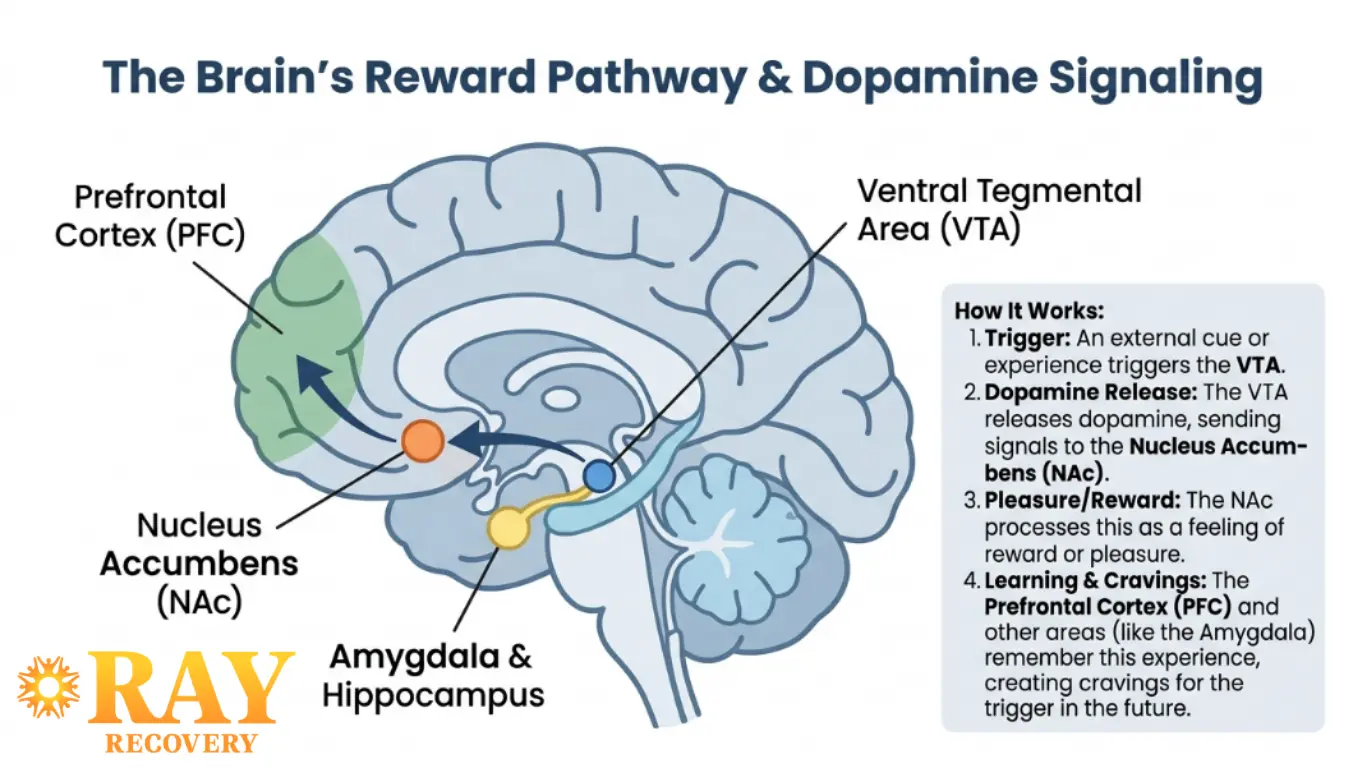
Semaglutide belongs to a class of medications called GLP-1 receptor agonists. GLP-1 is a naturally occurring hormone involved in regulating appetite, blood sugar, and the feeling of fullness after eating. That’s why these drugs were first approved for diabetes and later for weight management, they help people feel satisfied with less food.
What researchers are now exploring is whether the same receptors that dial down food cravings also play a role in the brain’s broader reward system, the same circuitry involved in cravings for alcohol, nicotine, and in some early research, even compulsive behaviors like gambling. The theory is that GLP-1 medications may reduce the reinforcing “pull” of alcohol in a similar way to how they reduce the pull of food, by acting on dopamine-related reward pathways rather than through some alcohol-specific mechanism.
It’s an elegant theory, and it’s supported by real data, but researchers are careful to point out that the exact mechanism isn’t fully understood yet. This is genuinely new territory, not settled science.
What This Research Doesn’t Mean
This is the part that matters most, and it’s the part that tends to get lost in headlines.
Semaglutide is not FDA-approved for alcohol use disorder.
Every study covered here used it off-label, meaning outside its officially approved use for diabetes and weight management. Doctors can still prescribe medications off-label when there’s a reasonable basis for it, but it’s a meaningfully different thing than an approved, guideline-backed treatment.
The studies are still small and short.
An eight-week trial, a six-patient case series, and even a large observational study without a control group all have real limits. Researchers studying this are explicitly calling for larger, longer trials before anyone treats this as settled. The CU Anschutz team, along with others, is already planning exactly that kind of follow-up work.
It comes with real side effects and risks.
GLP-1 medications commonly cause nausea, vomiting, and gastrointestinal discomfort, and combining them with heavy alcohol use can compound those effects. There are also contraindications and interactions that a doctor needs to evaluate on an individual basis, this isn’t a medication anyone should consider without medical supervision.
It isn’t a replacement for treatment.
Even in the most optimistic reading of this research, semaglutide is being studied as something that might reduce cravings, not as a standalone cure for alcohol use disorder. Alcohol use disorder is a complex condition that usually involves psychological, behavioral, and sometimes social components that a medication alone doesn’t address. The researchers behind these studies aren’t suggesting otherwise, and neither are we.
Where This Might Fit Alongside Real Treatment
If future research holds up, and that’s still an if, medications like semaglutide could eventually become one additional tool alongside the treatments that already work: therapy, medical support through withdrawal, and structured programs that address the reasons someone drinks in the first place, not just the craving itself.
That’s worth sitting with for a moment, because it points to something important: even in a future where this medication is approved specifically for alcohol use disorder, it would most likely be prescribed alongside therapy, not instead of it. The three medications currently FDA-approved for alcohol use disorder, naltrexone, acamprosate, and disulfiram, already work this way. They reduce cravings or create a deterrent, but they’re most effective when combined with counseling and behavioral support, not used in isolation.
If you’re someone who has heard about this research and found yourself hoping it might be an easier path than traditional treatment, that reaction is completely understandable. Cravings are exhausting, and the idea of a medication that quiets them is genuinely appealing. But right now, the honest answer is that the most effective, proven path still involves real treatment, and if a GLP-1 medication becomes part of that picture down the line, it’ll be as a complement to that work, not a shortcut around it.
How Alcohol Use Disorder Medication Already Works Today
It helps to understand how the three currently approved medications for alcohol use disorder actually function, since it shows the pattern any future semaglutide approval would likely follow.
Naltrexone blocks opioid receptors involved in the pleasurable effects of drinking, which can reduce the reward someone gets from alcohol and, for some people, make it easier to stop after one drink instead of continuing.
Acamprosate works differently, helping to stabilize brain chemistry that’s been disrupted by long-term heavy drinking, and is typically used to help people maintain sobriety after they’ve already stopped rather than to reduce active drinking.
Disulfiram takes a more direct approach, causing unpleasant physical reactions, nausea, flushing, a racing heart, if someone drinks while taking it, functioning as a deterrent rather than addressing cravings directly.
None of these medications are prescribed as a stand-alone fix. They’re most effective as one part of a treatment plan that includes therapy, and the research on semaglutide, if it eventually leads to an approved use for alcohol use disorder, would almost certainly follow that same model rather than replacing the therapeutic side of treatment. This matters especially for anyone whose drinking is tied to anxiety, depression, or another untreated condition, since a craving-reducing medication doesn’t address why someone started drinking in the first place. That’s the exact gap dual diagnosis treatment is designed to close, treating the substance use and the underlying condition together rather than expecting one medication to solve both.
If you’re curious whether a medication conversation makes sense for your specific situation, that’s a conversation to have with a doctor who knows your full medical history. If you’re looking at your relationship with alcohol more broadly and wondering what actual treatment could look like, that’s a conversation our team is glad to have with you.

Frequently Asked Questions
Can I ask my doctor for Ozempic specifically to help me drink less?
You can bring up the research with your doctor, and it’s a reasonable thing to discuss. Whether it’s appropriate for you depends on your full medical history, and any doctor prescribing it for this purpose would be doing so off-label, which is a decision between you and them.
Is semaglutide safe to take if I’m still drinking regularly?
This is exactly the kind of question that needs a doctor’s input rather than a general answer, since it depends on how much you’re drinking, your overall health, and other medications you may be taking. Heavy alcohol use and GLP-1 medications can both affect the gastrointestinal system, so combining them isn’t something to do without medical guidance.
Does insurance cover semaglutide for alcohol use disorder?
Since it isn’t FDA-approved for this specific use, insurance coverage for that purpose is inconsistent and often denied, even when it might be covered for diabetes or weight management. This is worth confirming directly with your insurance provider before assuming coverage either way. If you’re weighing treatment options more broadly, we verify insurance benefits directly so you have a real answer instead of a guess.
If this research keeps holding up, will it replace therapy or rehab?
Based on how the existing FDA-approved alcohol use disorder medications are used, most likely not. The pattern with naltrexone, acamprosate, and disulfiram is that they work best alongside therapy and structured support, not as a replacement for it. There’s no indication semaglutide would be different.
Where can I read the actual studies instead of just headlines?
The CU Anschutz trial, the USC study published in JAMA Psychiatry, and the Swedish cohort study are all covered by outlets reporting directly on the peer-reviewed research if you want to read further before drawing your own conclusions.
Why hasn’t semaglutide been approved for alcohol use disorder yet if the results look this promising?
Drug approval for a new use requires large, well-controlled trials specifically designed to test safety and effectiveness for that condition, and most of what exists so far are smaller trials, observational data, or case reports. Researchers involved in this work have said larger, longer confirmatory trials are already being planned, but that process realistically takes years, not months. Promising early data and formal approval are two very different stages, and it’s worth being patient with the difference rather than assuming approval is right around the corner.
If You’re Ready to Talk About Treatment
Whether or not this research eventually changes how alcohol use disorder gets treated, help exists right now for people who are struggling with drinking. Our team works with clients on real, individualized treatment plans, and we’re glad to talk through what that could look like for you or someone you love, medication questions included.
Call 888.839.2606 or reach out online to talk with our team.