
Quick answer: Borderline personality disorder (BPD) and substance use disorder co-occur at strikingly high rates, with studies estimating anywhere from 45% to 78% of people with BPD developing a substance use disorder at some point. This isn’t a coincidence, the same emotional intensity and impulsivity that define BPD also drive substance use as a coping mechanism, which is exactly why Dialectical Behavior Therapy (DBT), a treatment originally developed specifically for BPD, has become one of the most effective approaches for treating both conditions together.
If you or someone you love has been diagnosed with BPD and is also struggling with alcohol or drug use, or you suspect BPD might be part of a substance use pattern that hasn’t responded to typical treatment, here’s what the research actually shows and what integrated treatment looks like.
How Often Do BPD and Addiction Actually Co-Occur?
Quick answer: Very often, studies place the co-occurrence rate for BPD and substance use disorder among the highest of any psychiatric comorbidity, though the exact figure varies by study.

The numbers here span a range depending on methodology, but they’re consistently high across every study:
- A large-scale statistical summary notes that up to 83% of people with BPD also experience a mood disorder, and 73% have a substance use disorder
- A classic inpatient study of 137 people with BPD found 67% met criteria for a diagnosed substance use disorder, most commonly involving alcohol and sedative-hypnotics
- A more recent German clinical sample found a 12-month substance use disorder prevalence of roughly 45%, with alcohol abuse occurring at nearly 8 times the rate seen in the general population, and cannabis use disorder occurring at over 30 times the general population rate
- Some sources cite figures as high as 78% for lifetime substance use disorder risk among people with BPD
Whichever specific number you look at, the pattern is the same: this comorbidity isn’t an edge case, it’s closer to the norm than the exception.
Why BPD and Substance Use Are So Closely Linked
Quick answer: The core features of BPD, emotional dysregulation, impulsivity, chronic feelings of emptiness, and fear of abandonment, each independently increase the likelihood of turning to substances for relief.
Emotional dysregulation. BPD involves emotions that arrive faster, hit harder, and last longer than they do for most people. Substances offer a fast, if temporary, way to blunt that intensity, which reinforces the pattern even as it prevents someone from developing longer-term emotional regulation skills. Over time, this can create a cycle where the substance becomes the primary coping tool a person has, crowding out the chance to build other ways of managing distress.
Impulsivity. Impulsive behavior is a core diagnostic feature of BPD, and it extends naturally to substance use, making both the initial decision to use and the escalation toward heavier use more likely than in the general population.
Chronic emptiness and emotional pain. The persistent sense of emptiness that many people with BPD describe creates a strong pull toward anything that offers relief, even temporarily, and substances are an accessible option for many people.
Relationship instability and fear of abandonment. The intense, unstable relationships characteristic of BPD generate frequent emotional crises, and those crises are common triggers for substance use in someone already prone to using substances as a coping tool.
Shared trauma roots. Childhood trauma is common in the histories of people with BPD, and trauma is also independently one of the strongest known risk factors for substance use disorder. This overlapping origin is part of why the two conditions show up together so often, they frequently share a root cause rather than developing entirely independently.
Why Diagnosis Can Be Complicated
Quick answer: Substance use can mask or mimic BPD symptoms, and BPD traits can make substance use look like a separate, unrelated problem, which means an accurate diagnosis requires looking at both together rather than in isolation.
One clinical study found that when substance abuse was removed as a diagnostic factor, nearly a quarter of patients originally diagnosed with BPD no longer met the full criteria, suggesting that for some people, substance use plays a central role in how BPD-like symptoms present in the first place. This matters practically: a real assessment needs to untangle which symptoms are core to BPD, which are being driven or intensified by substance use, and which might resolve significantly once substance use is addressed. This kind of careful diagnostic work is part of why treating the two together, rather than assuming one diagnosis and treating it in isolation, tends to produce a clearer and more accurate picture.
Which Substances Are Most Commonly Involved, and Why
Quick answer: Alcohol and sedative-hypnotics show up most often in people with BPD, though cannabis use disorder appears at a strikingly elevated rate compared to the general population.
The classic inpatient study on this comorbidity found alcohol and sedative-hypnotics were the most frequently used substances among people with BPD, which fits a broader pattern: both substance categories act as depressants, directly counteracting the intense emotional arousal that characterizes BPD in the moment. More recent clinical data adds an important detail, cannabis use disorder appeared at over 30 times the general population rate in one clinical sample, a gap far larger than what’s seen with alcohol. This may reflect cannabis’s accessibility and its perceived (though not necessarily accurate) reputation as a gentler way to manage anxiety and emotional intensity compared to alcohol or other substances. None of this means other substances aren’t relevant, stimulants and opioids show up in this population too, but understanding which substances are most commonly reached for, and why, helps clarify what someone might actually be trying to manage in the moment they reach for a specific substance.
Why DBT Was Built for Exactly This Combination
Quick answer: Dialectical Behavior Therapy was developed by psychologist Marsha Linehan specifically to treat BPD, and its core skill areas directly target the same emotional and behavioral patterns that drive substance use, which is why it has become a leading approach for treating both conditions together.
The Four DBT Skill Modules and How They Apply to Substance Use
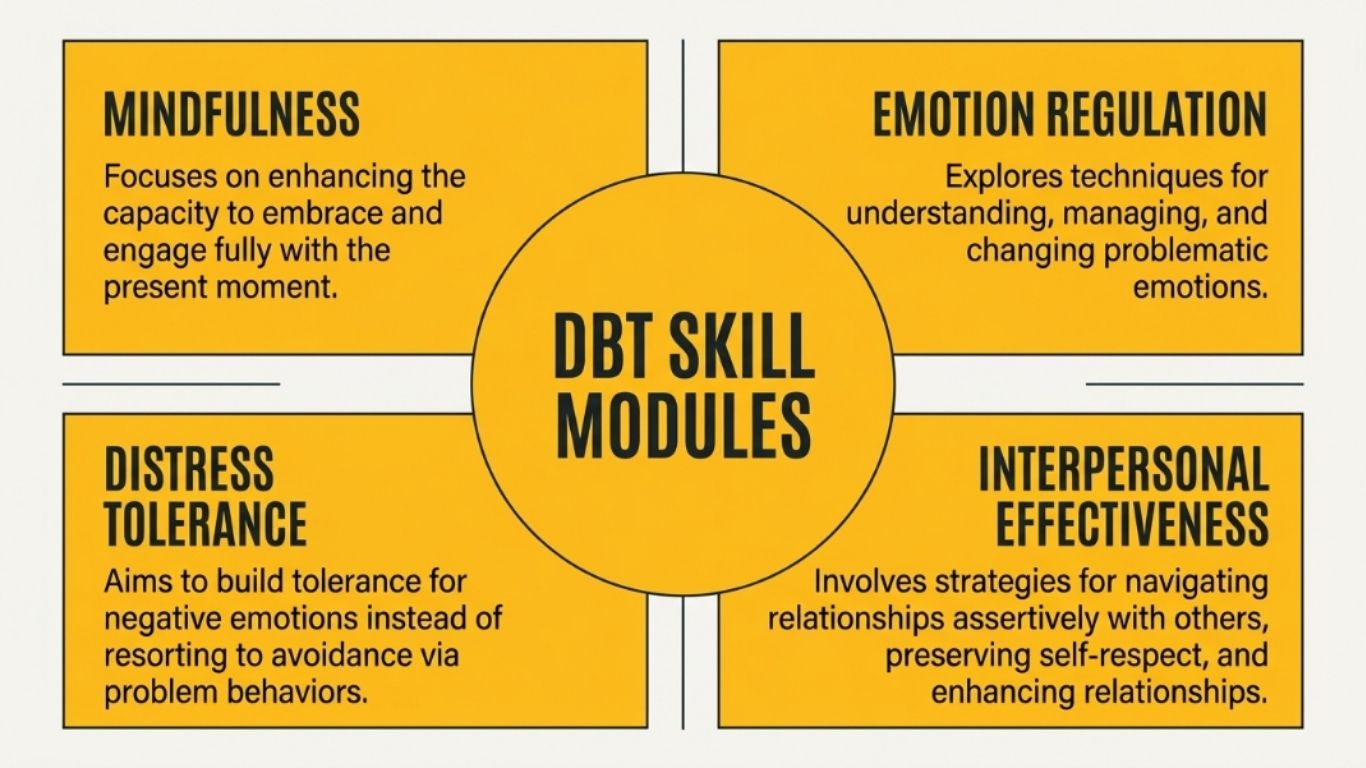
Mindfulness. DBT’s mindfulness component teaches people to notice emotions and urges without immediately acting on them, a direct counter to the impulsive, fast-acting pattern that connects BPD to substance use.
Distress tolerance. This module teaches ways to survive intense emotional pain without resorting to self-destructive behavior, including substance use, which is often the single most directly applicable skill set for someone managing cravings driven by emotional crisis rather than physical dependence alone.
Emotion regulation. Rather than relying on substances to manage overwhelming emotion, this component builds the capacity to identify, understand, and shift emotional states directly, addressing the root mechanism rather than just the behavior it produces.
Interpersonal effectiveness. Since relationship instability is both a core BPD feature and a common substance use trigger, this module builds skills for navigating conflict and maintaining relationships without the crises that often precede a return to use.
What Integrated Treatment Actually Looks Like
A real, combined assessment. Given how complicated diagnosis can be when both conditions are present, our team evaluates BPD traits and substance use together rather than treating one as incidental to the other.
DBT as a central component, through our dialectical behavior therapy program, built around the skill modules described above and applied directly to substance use triggers, not just general emotional regulation in the abstract.
Dual diagnosis care as the standard approach, not an add-on. Our dual diagnosis program treats BPD and substance use as one coordinated plan, which the evidence strongly supports over treating either condition in isolation.
Trauma-informed care where it fits. Given how often trauma underlies both conditions, our trauma therapy program addresses that shared root directly rather than treating it as a separate, unrelated issue to circle back to later.
Family involvement, carefully framed. Relationship instability is often part of the clinical picture with BPD, and family therapy can help loved ones understand the condition and respond in ways that support recovery rather than accidentally feeding the crisis-and-relief cycle that connects BPD to substance use.

Frequently Asked Questions
Can someone be misdiagnosed with BPD when substance use is actually the main issue?
It’s possible, since substance use can produce mood instability, impulsivity, and relationship difficulties that overlap with BPD symptoms. This is exactly why a careful, combined assessment matters, one clinical study found nearly a quarter of BPD diagnoses didn’t hold up once substance use was factored out separately. An accurate diagnosis takes real evaluation, not a quick checklist.
Is DBT only used for BPD, or does it work for substance use disorder without a BPD diagnosis too?
DBT was originally developed for BPD, but its skills, particularly distress tolerance and emotion regulation, have since shown real benefit for substance use disorder on its own, independent of a BPD diagnosis. If you don’t have BPD but struggle with emotional intensity connected to substance use, DBT may still be a strong fit.
How long does DBT treatment typically take?
DBT is traditionally a longer-term therapy, often delivered over six months to a year in its full form, though components can be integrated into shorter-term treatment programs depending on someone’s specific needs and level of care. Our team can walk through what a realistic timeline looks like for your situation during an assessment.
Does insurance cover DBT and dual diagnosis treatment for BPD and substance use?
Most insurance plans cover evidence-based therapy for diagnosed conditions, including DBT and dual diagnosis care. We verify your specific benefits before treatment starts so you know exactly what’s covered.
If I don’t have a formal BPD diagnosis but recognize these patterns in myself, should I still reach out?
Yes. A lot of people recognize pieces of this description without having a formal diagnosis already. A real assessment is how that gets clarified, you don’t need to arrive with a diagnosis already in hand to get an honest evaluation and the right next step.
Does treating BPD make self-harm risk worse before it gets better, similar to how substance withdrawal can feel harder before it improves?
This is a reasonable concern, and it’s part of why treatment for BPD, especially when substance use is also involved, needs real clinical structure rather than being approached casually. DBT specifically includes distress tolerance skills designed to build safer coping capacity as emotional intensity surfaces during treatment, rather than leaving someone without tools during a vulnerable period. This is exactly the kind of thing a real assessment and ongoing clinical relationship are built to manage safely.
Should substance use or BPD be treated first, or does it matter which comes first?
Based on the evidence, treating them separately or sequentially tends to produce worse outcomes than treating them together from the start. This is the core rationale behind dual diagnosis and integrated DBT-based treatment, rather than waiting for one condition to stabilize before addressing the other.
Ready to Talk About Integrated Treatment?
If you’re managing BPD alongside substance use, or you suspect the two are connected in ways that haven’t been fully addressed before, treatment that takes both seriously, together, tends to work where treating just one hasn’t. Our team builds care around DBT and dual diagnosis treatment specifically because the evidence supports treating these conditions as one connected picture, not two separate problems.
Call 888.839.2606 or reach out online to talk with our team.